
Biblical & Theological Issues


How Do We Know That We Have What The Biblical Writers Originally Wrote?
The Reliability and Trustworthiness of the Bible
by Paul D. Wegner
Rene Descartes’ maxim “De omnibus dubitandum” (All is to be doubted) is the heartbeat of contemporary society. So it is no surprise that Bible teachers are frequently asked questions about the validity of the books of the Bible—who wrote them, are they fictionalized, why are some writings included in the canon and others aren’t?
In responding to these questions, it is important to note at the outset that heresies and cults encroached on the early church, so much so that they had to protect their precious teachings and writings from these influences. Irenaeus (c. A. D. 175-189) describes this protection:
As I have already observed, the Church, having received this preaching and this faith, although scattered throughout the whole world, yet, as if occupying but one house, carefully preserves it. She also believes these points [of doctrine] just as if she had but one soul, and one and the same heart, and she proclaims them, and teaches them, and hands them down, with perfect harmony, as if she possessed only one mouth. For, although the languages of the world are dissimilar, yet the import of the tradition is one and the same. (Against Heresies 1.10.2).1
Many modern scholars theorize that the biblical books were simply created by those who had the most power or strongest influence at the time of the Bible’s formation. But this essentially ignores the evidence concerning how the early church viewed their sacred books. These writings were considered to have come from God through human authors and to contain divine revelation and instruction. It was, therefore, a sacred charge to protect and copy these works.
Tertullian (ca. 160 – 220 A.D.), one of the early church fathers from Carthage in North Africa, describes the practices of heretics in his day:
One man perverts the Scriptures with his hand, another their meaning by his exposition. For although Valentinus seems to use the entire volume, he has none the less laid violent hands on the truth only with a more cunning mind and skill than Marcion. Marcion expressly and openly used the knife, not the pen, since he made such an excision of the Scriptures as suited his own subject-matter (Prescriptions against Heretics 38).2
It was not that the early church was unaware of other writings (e.g., the Gospel of Thomas, the Gospel of Mary), but that they purposefully chose to avoid them. For example, Eusebius of Caesarea (c. 265-339) makes a clear distinction between authoritative works and those that are not:
Among the books which are not genuine must be reckoned the Acts of Paul, the work entitled the Shepherd, the Apocalypse of Peter, and in addition to them the letter called of Barnabas and the so-called Teachings of the Apostles. (HE 3.25.1-6)3
So what do we know about the accuracy of the biblical texts?
What Do We Have?
We do not have any of the original manuscripts (called “autographs”) of the biblical books due to the perishable nature of the materials upon which these early texts were written. But we have copies of these early texts—some New Testament manuscripts are dated within 75 to 100 years after they were written (e.g., P22, P46, P52, P66). It is sometimes hard for us to imagine, but before the introduction of movable print, literary works were painstakingly copied by hand. Sometimes copying mistakes crept into a text that was hand copied for any length of time. Even the latest books of the Bible underwent many centuries of hand copying before the appearance of the printing press in the fifteenth century A.D.
The Dead Sea Scrolls opened whole new vistas for examining the accuracy and reliability of the Old Testament texts. At present there are over 3,000 Hebrew manuscripts of the Old Testament. The situation is even better in the New Testament, where about 5,686 Greek New Testament manuscripts help us determine its reliability. This does not even take into account the thousands of manuscripts in other ancient languages (e.g., Syriac, Latin, Coptic, Aramaic), biblical quotations from the early church fathers, and the thousands of lectionaries (a collection of Scripture readings used for Christian worship).
To put this into perspective, compare the number of copies of other ancient works and their dates:
Herodotus, Histories
Date of Original Composition: c. 484-425 B.C.
Extant Manuscripts: About 75 manuscripts; oldest from the 1st century A.D.
Thucydides, History of the Peloponnecian War
Date of Original Composition: c. 460-400 B.C.
Extant Manuscripts: About 20; oldest surviving manuscript 1st century A.D.
Julius Caesar, Gallic War
Date of Original Composition: Composed 58-50 B.C.
Extant Manuscripts: Several extant manuscripts, but only 9 or 10 of good quality; the oldest is about 900 years after Caesar’s time.
Livy, Annals of the Roman People
Date of Original Composition: 59 B.C.-A.D. 17
Extant Manuscripts: Only 35 of the original 142 books survived; about 27 extant manuscripts; the oldest is a single manuscript (containing fragments of bks. 3-6) from the 4th century.
Tacitus, Histories and Annals
Date of Original Composition: c. A.D. 100
Extant Manuscripts: Only 4½ of the original 14 books of Histories and 10 (with portions of 2 more) of the 16 books of Annals survived in 3 manuscripts dating between the 9th and 11th centuries.
Suetonius, De vita Caesarum (commonly known as The Twelve Caesars)
Date of Original Composition: /c. A.D. 69-140
Extant Manuscripts: About 200 manuscripts; the earliest dates only to the 9th century.
It is interesting that the accuracy of these works is rarely questioned even though they have far less manuscript support and the support comes from a comparatively later time than the biblical texts.
Since the manuscript evidence for the biblical books is so abundant and since these manuscripts do not agree with each other in every detail, textual criticism is necessary to resolve questions of variation.
Textual Criticism
Briefly stated, textual criticism is the science and art that seeks to determine the most reliable wording of a text.4 It is a science because specific rules govern the evaluation of various types of copyist errors and readings, but it is also an art because these rules cannot be rigidly applied in every situation. Intuition and common sense must guide the process of determining the most plausible reading. Informed judgments about a text depend upon one’s familiarity with the types of copyist errors, manuscripts, versions, and their authors.
The job of the textual critic is very similar to that of a private investigator searching for clues as to the original reading of the text. It is reminiscent of the master detective Sherlock Holmes who could determine a number of characteristics of the suspect from the slightest of clues left at the crime scene. In our case the “crime scene” is the biblical text and often we have far fewer clues from which to work than we would like. Yet the job of the textual critic is extremely important, for we are trying to determine the exact reading of a text in order to know exactly what God has said and expects of man.
Textual Criticism Deals With Only a Small Portion of the Text
First of all, it must be pointed out that only a very small portion of the Bible has significant questions concerning its original reading. Bruce K. Waltke notes that in the Biblia Hebraica Stuttgartensia (the most recent critical edition of the Hebrew Bible) approximately one textual note appears for every ten words; thus 90 percent of the text is without significant variation.5 According to Shemaryahu Talmon, even the errors and textual variations that exist “affect the intrinsic message only in relatively few instances.”6 Similarly in the New Testament, the fourth edition of the United Bible Societies’ Greek New Testament text notes significant variants7 regarding approximately 500 out of 138,020 words, or only about 0.36 percent of the text. Textual criticism, therefore, mainly concerns itself with this small portion of the biblical text called “variant readings.” A “variant reading” is any difference in wording (e.g., differences in spelling, added or omitted words) that occurs among manuscripts.
Importance of Textual Criticism
The importance of textual criticism is threefold. First and foremost, it attempts to establish the most reliable reading of the text. Second, in cases where a definitive reading is impossible to determine, it can help to avoid dogmatism. Third, it can help the reader better understand the significance of marginal readings that appear in various Bible translations. Textual “criticism” is not a matter of making negative comments or observations about the biblical text; instead it is the process of searching through the various sources of biblical texts to determine their most accurate or reliable reading. And this process can lead to increased confidence in the reliability of the biblical texts. Sir Frederic Kenyon (d. August, 1952), former Director of the British Museum and a New Testament text critic, summarizes the overall favorable result of New Testament textual criticism: it is reassuring at the end to find that the general result of all these discoveries and all this study is to strengthen the proof of the authenticity of the Scriptures, and our conviction that we have in our hands, in substantial integrity, the veritable Word of God.8
Much has changed in the field of textual criticism during the last five decades since Kenyon. Manuscripts from the Dead Sea area have revolutionized Old Testament textual criticism, and more Greek manuscripts and fragments are now available for New Testament studies (i.e., manuscripts from St. Catherine’s Monastery presently number 301; one of the newest manuscripts published, P116, is a fragment of Hebrews 2:9-11 and 3:3-6).9 Even though we have more evidence today than previous generations, the issues of textual criticism have become more complex. Still there remain relatively few significant variants in the Bible and, among these variants, there is very little difference in meaning and content. To help put this into perspective, scholars agree that no theological doctrine hinges on a textual variant10 and that there are more differences between various English translations of the New Testament than among Greek manuscripts.11
Goal of Textual Criticism
Since no autographs are available today of either the Old or New Testaments, the general task of the text critic is to work back as closely as possible to those autographs. This is no easy task, for textual criticism is also affected by higher-critical matters, such as how and when a text reached its final form.
- Goal of Old Testament Textual Criticism
Although evidence of the earliest stages of the transmission of the Old Testament is extremely scarce, it is nevertheless a reasonable goal to attempt to determine the earliest form of the canonical text. Waltke urges Old Testament text critics to “resist the temptation to lower their sights from the high ideal of recovering final text(s) that emerged in Israel before prophecy ceased in Israel.”12 It is appropriate to ask which of the texts we know to have existed before the first century A.D. (e.g., Dead Sea Scrolls, LXX, SP) most likely reflect the original form of the Hebrew text. For example, did Deuteronomy 27:4 originally contain a prescription of worship at Mt. Ebal as the MT states or at Mt. Gerizim as the SP has it?13 Is the MT correct in saying that the Israelites spent 430 years in Egypt (Exodus 12:40) or are the LXX and SP correct that this period included the time spent in both Egypt and Canaan? Waltke concludes his discussion on the aim of Old Testament textual criticism as follows:
The text critic’s aim will vary according to the nature of the book. If a book had but one author, then the critic will aim to restore his original composition; if it be an edited text then he will seek to recover the final, canonical text. If he turns up more than one final text, he will turn his data over to the literary and canonical critic to determine whether the text is in process of developing into a final canonical text or whether it existed in more than one canonical form.14
We question whether more than one authoritative form of a biblical text ever existed. Instead we are in substantial agreement with Adam van der Woude’s contention that there has always been a relative “uniformity” of the textual tradition in the religious circles around the temple, even amidst the “plurality” that developed before the turn of the century.15 Waltke’s aim for Old Testament textual criticism indeed indicates the complex nature of the Old Testament text, but we believe that it is better to add one more word to Waltke’s aim, namely to attempt to recover the “original final, canonical form of the text” or, as some scholars call it, the pre-Masoretic Text or proto-Masoretic Text. The reason being is that often when scholars speak of the final form of the text, they are often referring to the Massoretic Text, but there are several places modern scholars believe that we can improve upon the present Massoretic Text (e.g., Gen. 14:14; Isa. 7:8b; Ps. 145:13-14). Another way of saying this is that the goal of Old Testament textual criticism is to determine the final, authoritative form which was then maintained by the scribes and was later recorded in the canon.16 The form of the text that later became finalized in the canon may not be obtainable in every case, nevertheless it is a plausible goal in the vast majority of the cases, especially given the number of materials discovered in the twentieth century.
- Goal of New Testament Textual Criticism
While questions regarding the original text sometimes surface, a substantial portion of the New Testament text remains unquestioned and most likely represents the text of the original autographs or very close to it. When the writers of New Testament Scriptures were still alive, it is unlikely that people could have changed them without their authors pointing out such discrepancies. Paul sometimes requested that his letters be circulated to other churches (Colossians 4:16), and thus the autographs must have been copied almost immediately; this would have made it unlikely that others could substantially modify the text without being detected. The early church also had a great reverence for these works (2 Tim. 3:16; 2 Pet. 1:20-21) and their authors (2 Pet. 3:15-16), so it is doubtful that they would change their writings. Revelation 22:18-19 even includes a curse to anyone who attempts to change its text. Thus a plausible goal for New Testament textual criticism is the recovery of the original reading of a biblical text; or in only a few cases it may be necessary to identify the earliest possible reading.17 Bruce M. Metzger, Professor Emeritus of Princeton University, states it this way:
Although in very many cases the textual critic is able to ascertain without residual doubt which reading must have stood in the original, there are not a few other cases where he can come only to a tentative decision based on an equivocal balancing of probabilities. Occasionally none of the variant readings will commend itself as original, and he will be compelled either to choose the reading which he judges to be the least unsatisfactory or to indulge in conjectural emendation. In textual criticism, as in other areas of historical research, one must seek not only to learn what can be known, but also to become aware of what, because of conflicting witnesses, cannot be known.18
In many cases, the interval between the authorship of a biblical book and its extant manuscript evidence is relatively short. The plethora of New Testament manuscripts is a great benefit when trying to determine the original reading, for it is easier to sift through and evaluate the various extant readings than to emend texts with no evidence. The goal of New Testament textual criticism, then, is to determine the most plausible original reading out of a large body of evidence.
A Brief Description of the Process of Textual Criticism
It is remarkable that early manuscripts and fragments of the New Testament exist today since the early church had no great libraries or sanctuaries to store their sacred books and was often persecuted. In A.D. 303, Diocletian ordered all sacred Scriptures of the Christians to be burned. However, after Emperor Constantine accepted Christianity, he halted persecution of Christians in the so-called “Edict of Milan” (A.D. 313) and declared freedom of worship for citizens of the Roman Empire.19 During this period the Christian Church grew so fast that the Emperor requested Eusebius to provide fifty new copies of the Scripture for the churches of Constantinople. From about the fourth century A.D. on, it was primarily the work of monks to study and copy the Scriptures.20
A basic understanding of the mechanics of New Testament textual criticism can help us appreciate the reliability of Scripture. However, Bruce Metzger warns, “To teach another how to become a textual critic is like teaching another to become a poet.”21 Even though natural talent is certainly a factor, the skills and rules related to textual criticism can be honed and sharpened by regular interaction with and examination of the texts. New Testament textual criticism is primarily the study of variants:
- The greatest number of “variants” are differences or errors in spelling. For example, the author of Codex Vaticanus spells “John” with only one “n” instead of the more common two ( Ιωάννης, Ioannes). This type of variant makes no difference in the meaning of the text.
- The second largest group of variants arises because there is no English equivalent for the Greek. For example, in Greek a person’s name may or may not be preceded by an article (“the”). The phrase “the good man” could also be written in Greek as “the man, the good one,” whereas in English both phrases are translated as “the good man.” This type of variant also makes no difference in the meaning of the text.
- It was very rare for a scribe to accidentally corrupt a word or phrase when copying, but it did happen. One scribe accidentally wrote the Greek letter pi instead of phi in Luke 6:41, rendering the text, “Let me take the fruit (κάρπος karpos ) out of your eye” instead of “Let me take the speck (κάρφος karphos ) out of your eye.” These types of errors are easily identifiable.
Thus the job of the textual critic is to examine the variants and determine the most plausible reading of a passage. However, in order to effectively analyze the variants, several related issues need to be considered.
Eclectic Text versus Single Text
One of the first decisions a New Testament textual critic must make is whether one text may have been preserved more accurately than others and so use only that text, or whether it is better to choose the most accurate readings from all the New Testament texts and combine them into an eclectic text. The latter seems more reasonable since errors have been incorporated into every text at some point in time through the transmission (or copying) process. Thus a text which combines the most plausible readings will probably read closer to the original Greek text than any single text.
Eclectic Text Collects the best readings from many manuscripts
Single Text Uses the readings from a single text
An eclectic text weighs and compares the various readings, incorporating the best into one text. A single text approach to textual criticism assumes one manuscript or group of manuscripts has superior readings. This issue is vital to the King James Debate, since those who argue for the authority of the King James Bible often do so based upon the supposition that the Byzantine textual family (or what is sometimes called the “Majority Text”) is superior. However, the King James Version was translated from six or seven medieval manuscripts. By comparison, today we have available papyrus manuscripts dating to the second century A.D. whose early readings should at least be considered when attempting to determine the original text.
Relationships between Manuscripts
The classification of New Testament texts into textual families was developed by Westcott and Hort and has been expanded by New Testament textual critics. The concept of textual families is simple—manuscripts that are copied from one another bear strong similarities to each other. Generally once an error has been made, it remains within that family. However, comparing manuscripts with those from another family is rare.
Relationships between textual families
Each dot represents a manuscript; each line indicates which ms(s) were used as the basis for further copies.
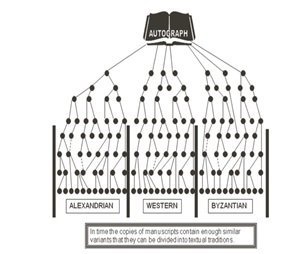
Each copy contains errors from the mss it duplicates, as well as new errors resulting from the recopying process.
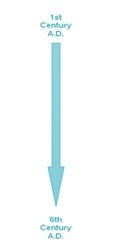
Textual families were often restricted to the locality where they where copied, unless a manuscript was transported to a different region for reasons such as war or famine. Families are thus named for the area where they developed. Scholars categorize manuscripts into related families and then evaluate these families to determine which are more accurate. Scholars generally have ranked the accuracy of these textual families as follows (in order from most to least accurate):
- Alexandrian Family
- Western Family
- Byzantian Family
When manuscripts contain characteristics from more than one family, they are sometimes referred to as “mixed manuscripts.”
Procedure for New Testament Textual Criticism
1. Collecting the Evidence
The most difficult and yet the most important part of New Testament textual criticism is collecting all the available manuscripts and resources necessary to make an informed decision. The New Testament text critic must carefully study all of the evidence, both internal and external, before making this decision. Internal evidence is found within the text; for example the literary context, particular grammatical or spelling conventions that the author uses, or literary forms like parallelism or chiasms. External evidence is found outside the text from other manuscripts or source documents. We believe that a careful balance of both internal and external evidence is the best way to determine the most plausible reading of a Greek text. When the evidence is almost equally divided between possible readings of a text, it is probably wisest to weigh the external evidence more strongly.
a. Internal Evidence
Internal evidence from the passage itself can help determine the original reading. For example, if the author of the Gospel of John always used the name “Christ” for “Jesus,” but the name “Jesus” appears instead in a manuscript, this is a plausible corruption. There may be many different types of clues within a passage that help confirm a specific reading (e.g., parallel units, certain characteristics of an author, grammatical issues), which is why skill and familiarity with the manuscripts is useful. Some commentaries make note of internal evidence, but probably the most helpful work is the textual commentary on the Greek text published by the United Bible Societies.22 This work, written by the same scholars who edited the United Bible Societies’ Greek text, explains why the committee chose specific readings and the most pertinent information that was used.
b. External Evidence
There are three primary sources of external evidence, illustrated in the following chart:
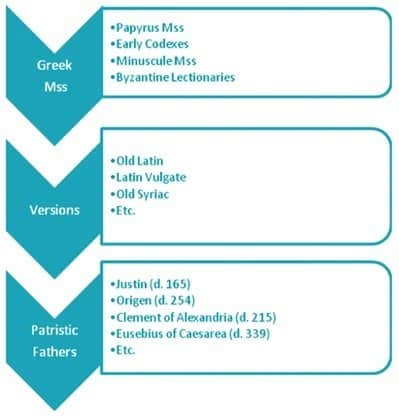
ORIGINAL TEXT
CRITERIA/ RATIONALE
1. Date /The earliest reading is closest in time to the original text and thus there was less opportunity for corruption to occur.
2. Accuracy /Accuracy is determined by how many errors are found in a given manuscript or family.
3. Independence of witnesses /Witnesses that are related to each other should be considered one source since they were probably copied from each other (as in textual families).
All of this external evidence must be evaluated and ranked since some will be considerably more important than others. The following criteria are helpful for this purpose:
It is in the evaluation process that skill is required by the textual critic, for each criterion cannot be weighed equally. Some sources will be weighted more heavily because they are older or come from more accurate text families. In general, early manuscripts take precedence over later ones since later manuscripts are further away from the originals and have probably gone through more stages of copying—each time a text is copied errors may creep in. The second criterion is important because certain text families have fewer errors to begin with. It is also important to consider the independence of witnesses; if two manuscripts are related (or copied from the same text) they should be considered as one witness so as not to skew the evidence for that reading. It is preferable to collect evidence for specific readings from a wide geographical area to eliminate as much as possible copying from related sources. However, this criterion is sometimes difficult to evaluate since the geographical origin of some manuscripts is not always known.
It has been said that the Church Fathers quoted the New Testament so extensively that if all other sources of the New Testament were to be destroyed, it could be reconstructed from the Church Father’s quotations alone. While some Church Fathers date to a very early period and quote extensively from the New Testament, they must be used with care since they sometimes quoted from memory or modified the text to address a given situation. The great importance of quotations from Church Fathers is that they help us to localize and date various readings and types of the text.
Recently published editions of the Greek text23 have already compiled much of the evidence for the various readings in their textual apparatuses.
2. Evaluating the Evidence
a. Unintentional Changes
Copyists made similar types of mistakes; a few of the most common are:
- Mistaken letters: confusion of similar looking letters.
- Homophony: substitution of similar sounding words.
- Haplography: omission of a similar looking letter or word.
- Dittography: a letter or word that has been written twice rather than once.
- Metathesis: reversal in order of two letters or words.
- Fusion: incorrect word division that results in two words joined as one.
- Fission: incorrect word division that results in one word being written as two.
- Homoioteleuton: an omission caused by two words or phrases that end similarly.
- Homoioarkton: an omission caused by two words or phrases that begin similarly.
- Other errors: sometimes scribes were not sufficiently careful and unintentional mistakes were incorporated into their manuscripts.
b. Intentional Changes
These inadvertent errors noted above are sometime easily recognized. But other errors can be harder to detect, as Bruce Metzger observes: “scribes who thought were more dangerous than those who wished merely to be faithful in copying what lay before them.”24 Intentional errors are much harder to detect and correct since it is generally more difficult to determine why certain changes were made. Errors due to intentional changes were most likely introduced when the copyist thought there was a spelling or theological mistake, or when the text did not seem to correspond to another biblical passage.
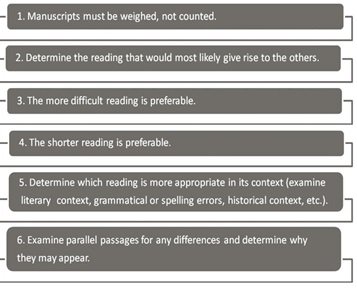
- Determining the Most Plausible Reading
The following principles are key to determining the most reliable reading of a text:
Conclusion
It would be naïve to think that we will not continue to have textual puzzles. Biblical scholars will continue to weigh evidence differently and thus arrive at different translations of certain passages. But careful examination of internal and external evidence, along with judicial application of textual critical principles, will support our confidence that the texts we now possess of the Old and New Testaments substantially reflect the reading of the autographs and are thus trustworthy.
Paul D. Wegner is Professor of Old Testament at Phoenix Seminary. He is the author of The Journey from Texts to Translations: The Origin and Development of the Bible (Baker, 1999) and A Student’s Guide to Textual Criticism of the Bible: Its History, Methods and Results (InterVarsity, 2006).
NOTES
1 A. Roberts and J. Donaldson, eds., Ante-Nicene Fathers: Translations of the Writings of the Fathers Down to A.D. 325 (Grand Rapids: Eerdmans, 1991) 1:331.
2 Roberts and Donaldson, Ante-Nicene Fathers, 3:262.
3 K. Lake and J. E. L. Oulton, Eusebius: The Ecclesiastical History, with an English Translation, 2 vols., LCL (Cambridge, Mass.: Harvard University Press, 1926-32) 1:293.
4 See P. Kyle McCarter, Textual Criticism: Recovering the Text of the Hebrew Bible, GBS: OTS (Philadelphia: Fortress, 1986), 18.
5 “Old Testament Textual Criticism,” in Foundations for Biblical Interpretation, edited by David S. Dockery, Kenneth A. Matthews, and Robert Sloan (Nashville: Broadman, 1994), 157.
6 Shemaryahu Talmon, “Old Testament Text,” in Cambridge History of the Bible, ed. P. R. Ackroyd, C. F. Evans, G. W. H. Lampe and S. L. Greenslade (3 vols.; Cambridge: Cambridge University Press, 1963-70) 1.161.
7 The textual appendix of this Greek text only notes passages where there are significant questions regarding the text.
8 Frederic G. Kenyon, The Story of the Bible, 2nd ed. (London: John Murray, 1964), 113.
9 Amfilochios Papathomas, “A New Testimony to the Letter of the Hebrews,” Journal of Greco-Roman Christianity and Judaism 1 (2000): 18-24.
10 Waltke, “The Textual Criticism of the Old Testament” in Biblical Criticism: Historical, Literary, and Textual, edited by R. K. Harrison et al. (Grand Rapids: Zondervan, 1978), 65; Bruce M. Metzger, The Text of the New Testament: Its Transmission, Corruption, and Restoration, 3rd ed. (New York: Oxford University Press, 1992), 112.
11 Paul D. Wegner, The Journey from Texts to Translations (Grand Rapids: Baker, 1999), p. 213. See also David A. Black, New Testament Textual Criticism: A Concise Guide (Grand Rapids: Baker, 2001), 13.
12 Waltke, “Aims,” 101.
13 There is no question that differing theological considerations affected the reading of this passage. See James A. Montgomery, The Samaritans: The Earliest Jewish Sect (Philadelphia: Winston, 1907), 35.
14 Waltke, “Aims,” 107-8.
15 Adam S. van der Woude, “Pluriformity and Uniformity: Reflections on the Transmission of the Text of the Old Testament,” in Sacred History and Sacred Texts in Early Judaism: A Symposium in Honour of Adam S. van der Woude, edited by Jan N. Bremmer and Florentino García Martínez (Pampen: Kok Pharos, 1992), 151-69.
16 Paul Wegner, A Student’s Guide to Textual Criticism of the Bible: Its History, Methods and Results (Downers Grove, Ill.: InterVarsity, 2006), 37.
17 Eldon J. Epp, “Textual Criticism (NT),” Anchor Bible Dictionary, David N. Freedman, ed., 6 vols. (New York: Doubleday, 1991) 6:412.
18 Bruce M. Metzger, Text, 246.
19 J. Stevenson, A New Eusebius. Documents Illustrating the History of the Church to AD 337 (Rev. ed.; Revised by W. H. C. Frend; London: SPCK, 1987), 284-85.
20 B. M. Metzger, Text, 19. These rules appear in J. -P. Migne, PG xcix.1739-40.
21 B. M. Metzger, Text, 211.
22B. M. Metzger, A Textual Commentary on the Greek New Testament (2d ed.; Stuttgart: Deutsche Bibelgesellschaft, 1994).
23 The Greek New Testament (4th ed.; Stuttgart: United Bible Societies, 2000) and Novum Testamentum Graece (27th rev. ed.; Stuttgart: Deutsche Bibelgesellschaft, 2006).
24 B. M. Metzger, Text, 195.